

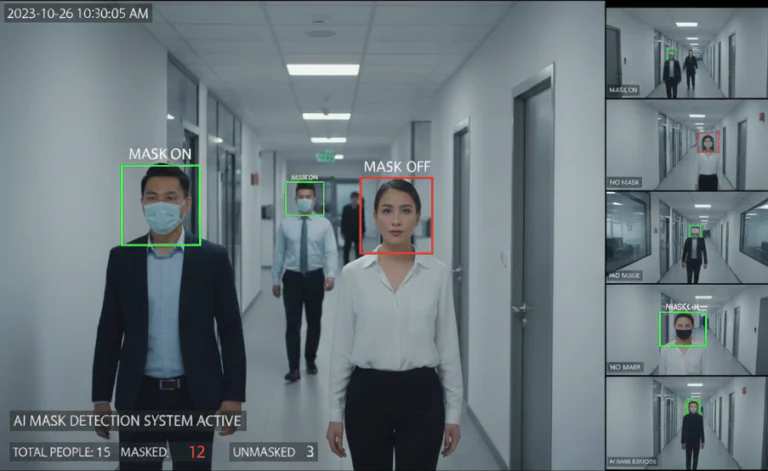
AI-based facial recognition is one of the most effective technologies in the modern business world. It can identify key customers within seconds, automate access control, or filter out unwanted individuals. However, before deploying it, almost every executive and legal advisor asks the same question: How can this be used lawfully under the strict GDPR and the new EU AI Act?
The answer lies not in rejecting the technology, but in the principle of Privacy by Design, that is, built-in data protection.
How does lawful facial recognition work?
What does facial recognition with built-in privacy mean? The point of privacy-by-design facial recognition is that the system does not store raw image files or videos of the people it observes. From the live camera feed, the visual AI generates a mathematical code, a so-called „face template”. If the person is not on a pre-approved list (for example, a VIP list or employee access control), the system anonymizes the data immediately and irreversibly, which prevents mass surveillance.
The AI Act and the limits of biometric identification
The European Union’s regulation on artificial intelligence (the AI Act) strictly regulates the processing of biometric data. Its aim is to prevent abuse, but this does not mean that businesses have to give up the benefits of facial recognition.
The key is rule-based, targeted operation:
- Permitted use: If you want to increase the security of protected areas in an office building, laboratory, or plant, the system can be used lawfully and effectively for access control with employees’ consent, even without a physical access card.
- Retail analytics: If you measure customer demographics or behavior in your store, the system produces only anonymous, aggregated statistics. Faces are anonymized immediately, so no personal data is compromised.
Flexible integration: cloud or on-premise?
The other pillar of data security is the technology architecture. Modern facial recognition software has to fit the company’s existing infrastructure and security protocols.
Professional systems can now be integrated in two ways:
- On-premise or edge deployment: Data is processed locally, on the company’s own servers or on the cameras themselves. The data never leaves the building, which guarantees the highest level of data security.
- Cloud connection: For new applications under development, the functions can be built in directly through an SDK, or flexibly connected through cloud API endpoints.
Balancing security and business value
Facial recognition does not have to pose a privacy risk. If legal and ethical compliance is built into the foundations of the technology during development, cameras can increase efficiency and security without endangering privacy.
The VeriDome facial recognition system offered by Vitarex is built for exactly this kind of fine-tuning: it provides fast identification with high accuracy, while supporting the requirements of the GDPR and the AI Act with built-in features.
Would you like to integrate AI-based identification securely? Contact our experts for a free technology and data protection consultation! Click here for the consultation!