

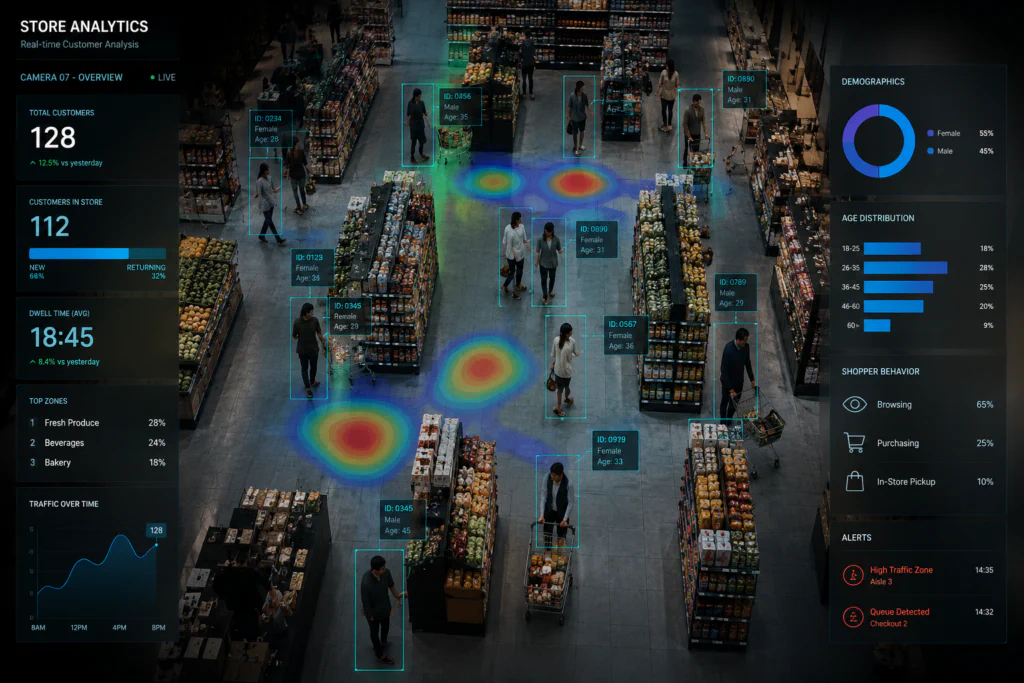
Most businesses have dozens of security cameras running in their offices, warehouses or shops. In reality, however, these expensive devices are completely passive 99% of the time: they simply record the image, and we only touch them when we need to investigate an incident afterwards, or to prove shoplifting or unauthorized entry.
What if these cameras did not just cost you maintenance money, but supported your business decisions with real-time data, optimized space usage and directly increased your revenue?
With the spread of artificial intelligence and visual AI, cameras have finally stepped out of the role of passive observer.
What is camera-based spatial analytics?
What are camera-based spatial analytics and person detection?
Camera-based spatial analytics is an AI-based technology that turns the footage of your existing security cameras (CCTV) into structured, measurable data. The system can automatically recognize objects and people moving in physical space (person detection) without carrying out mass surveillance, thus enabling objective process optimization.
How can physical space be measured? (Technology comparison)
Many decision-makers try traditional people counters or WiFi-based sensors, but their accuracy and depth are strongly limited. The table below shows why visual AI is a breakthrough:
| Aspect | Traditional sensors / WiFi | VeriDome Visual AI |
|---|---|---|
| Accuracy | Low/Medium (due to occlusions or switched-off WiFi) | Extremely high (real-time visual tracking) |
| Infrastructure needs | New, expensive hardware and sensors must be installed | Can be connected to existing IP cameras after the fact |
| Depth of analysis | Measures only a plain count or approximate presence | Measures heatmaps, routes, dwell time and queue length |
| Data protection | Often involves significant privacy compromises | GDPR-compatible, with optional instant anonymization |
3 specific areas where spatial analytics brings immediate ROI (return on investment)
1. Shops and FMCG: optimizing customer routes
In retail, shelf layout and promotion placement are critical. With multi-object tracking (MCMOT), the system produces visualized heatmaps and route analyses. You will see exactly which areas of your shop are underused, where customers get congested, and where they make real decisions.
2. Queue and waiting management
There is nothing worse than a dissatisfied customer standing in line. AI can measure queue length and waiting time in real time. If the system detects congestion, it immediately alerts management, so by dynamically reallocating resources (e.g. opening a new checkout), the user experience and compliance with SLAs can be radically improved.
3. Logistics and industrial environments: reducing congestion and risks
In a warehouse or manufacturing plant, analyzing material handling routes is worth its weight in gold. Based on historical space-usage data, bottlenecks can be eliminated, lead times reduced, and occupational safety compliance increased (for example by automatically detecting protective equipment).
Cameras used to only record, now they finally become a decision-support tool
In modern business operations, the lack of real data equals the loss of control. You do not need to replace your existing camera system to get objective, measurable data about how your physical spaces operate. The VeriDome spatial analytics platform developed by Vitarex is a business-validated, scalable system that gets the maximum business value out of your existing cameras, while meeting the strictest data protection requirements.
Take the next step in data-driven operations! Request a tailored business needs assessment and learn the real story of your physical spaces. Click here for a no-obligation consultation!