

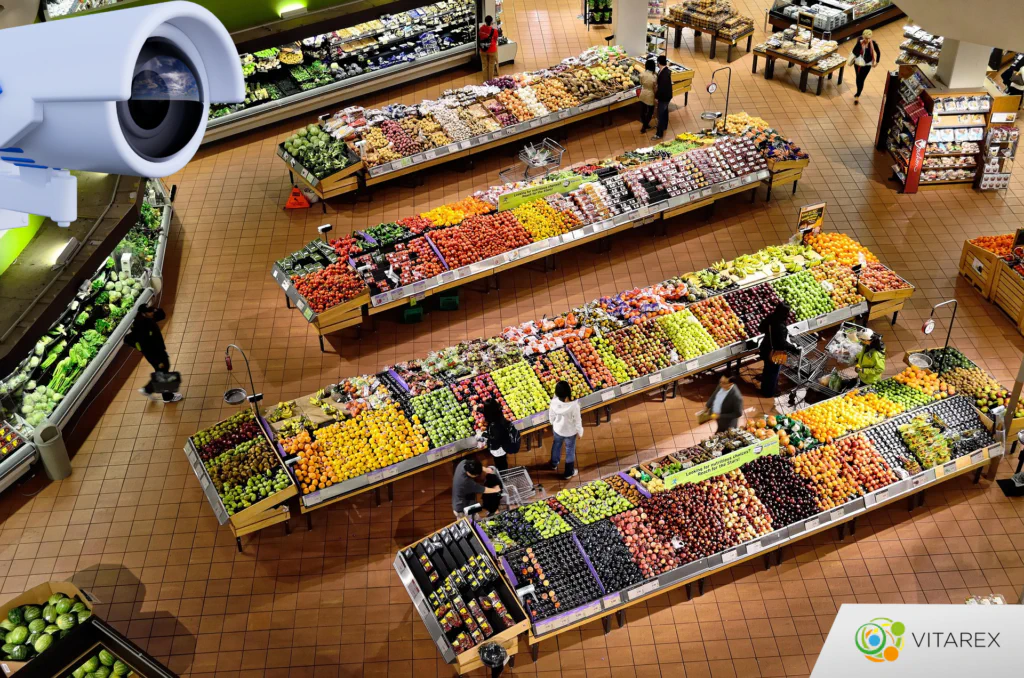
When we talk about artificial intelligence, we tend to think of it as the distant future. In reality, the industrial applications of visual artificial intelligence already deliver tangible, measurable profit and efficiency gains for Hungarian companies too.
But how does this technology work in everyday business practice? Let’s look at four different areas where data-driven analysis of camera images fundamentally changes operations.
How does AI track objects?
What is multi-object tracking and how does it support security? Multi-object tracking AI is an advanced technique that makes it possible to continuously follow selected objects (people, vehicles, products) within a given physical space. The system can keep the position of the target person or object even when it moves from the field of view of one camera to another, or is temporarily occluded in a crowded environment.
1. Retail and FMCG: digitalizing the customer experience
Web shops see exactly what we click on and how long we think about a product. Physical stores have so far been operating „in the dark”. Precise customer route analysis, however, brings the precision of web shops into real spaces.
- The system provides anonymous, aggregated demographic and behavioral statistics about the visitor mix.
- Decision-makers can measure the success of marketing campaigns based on objective data, and optimize shelf layout based on real heatmaps.
2. Industry and manufacturing: automated occupational safety
In heavy industry, factories and plants, complying with safety regulations can be life-saving, but continuous manual checking is almost impossible.
- What do you see in the picture? A professional working in a factory environment who is wearing the mandatory personal protective equipment (PPE). Visual AI monitors exactly such situations: based on the camera images, it can detect in real time whether hard hats, high-visibility vests or masks are present. If someone enters a hazardous zone without protective equipment, the software sends an immediate alert, preventing workplace accidents.
3. Logistics and warehousing: eliminating bottlenecks
In high-traffic logistics centers, every wasted minute costs serious money. In modern warehouses, warehouse process optimization is no longer conceivable without intelligent cameras.
- The system continuously analyzes material handling routes and the intersections of forklift and pedestrian traffic.
- With the help of historical data, the points of logistics congestion and underused capacities can be identified precisely, so lead times can be reduced radically.
4. Hospitality and events (HoReCa): premium customer care
In hotels and at high-profile events, personalized attention is the greatest competitive advantage. Every VeriDome case study proves that intelligent face recognition can take the guest experience to the next level.
- The face recognition module, using your existing IP cameras, can filter guests in real time against rule-based lists (e.g. VIP status).
- As soon as a key regular guest walks into reception, the system sends a discreet signal to staff, who can then greet them by name, prepared for their special needs.
How do you get started?
Introducing visual AI does not require building a costly, completely new infrastructure. A professional, modular platform can transform the footage of your existing cameras into real-time business value.
The VeriDome spatial analytics and face recognition solutions, backed by Vitarex expertise, provide exactly this scalability for your business.
Make the operation of your physical spaces measurable! Get in touch with our consultants, and let’s look together at what hidden growth opportunities exist in your current camera system.