

In the previous post we looked at the background of face recognition. Now let’s see how it works in practice.
What is a face template good for?
A face template can be used in several ways, for example:
- Identification: if we store enough face templates of a person as samples, we will most likely be able to identify them again later.
- Finding connections between images or videos: for example, we can determine whether the same person appears in two different recordings, even if time has passed or conditions have changed in between.
- Building a background database: by storing face templates, we can build a system that recognizes returning people quickly and efficiently, even in real time.
This is the foundation of face recognition: a technology that turns a face into a digital „template” so that it can then be recognized, tracked or identified quickly and accurately.
It is important to note that many technological „add-ons” that are commonly called face recognition can actually be performed without identifying the person at all. Examples are determining gender, age or ethnicity, which does not require face recognition; AI models can estimate these with relatively good accuracy on their own. Emotion analysis is likewise independent of face recognition.
What can affect the effectiveness of face recognition?
Face recognition is appearing in more and more areas, and although we might think it is nearly infallible, its accuracy is actually influenced by many factors:
- Camera image quality: if cameras are mounted too high, they see faces at a poor angle, which degrades performance. It is also a problem if people, or objects, block one another from view when face recognition is needed. If you want to cover too large an area, the faces in the image will be too small to identify. Old, low-resolution cameras can also lead to weaker results.
- Lighting: in an environment that is too dark or too bright, the system has a harder time detecting the face.
- Head rotation, partial occlusion: if someone is seen from the side or partly covered (for example wearing a cap, sunglasses or a mask), the chances of recognition decrease, because the system may already fail at finding the face (face detection).
- Wearing a mask: since the COVID period this has been a particularly important factor, although more advanced systems already account for it.
The goal is to keep the error rate of identification as low as possible, and this requires as much data as possible.
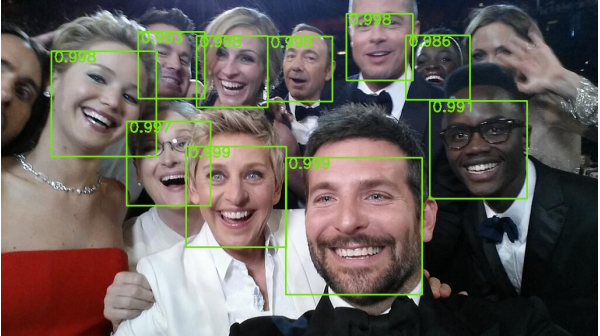
Not every face was found: in some cases the person was covered too much or partly cut off by the edge of the image. (source: MIT Technology Review)
Everyday use cases
Face recognition is now much more than a sci-fi prop. We use it in many areas of our private lives, and we also encounter countless business applications.
In everyday life, we meet it, for example, in unlocking mobile phones and authenticating on them (e.g. iPhone Face ID), or when it helps us tag photos in online services (e.g. on social media). In some services it serves a security or verification function, such as a kind of „two-factor” identification during a bank video call. In some countries, automatic airport gates use face recognition to enable faster, contactless boarding and entry.
In business, too, the technology can be used in many ways, for example to control protected areas, or in access control systems to raise an alarm on unauthorized entry. In marketing, it can help recognize regular customers in a shop or hotel, and it can also be used to identify guests. Many industries are already experimenting with this, from event organization to burger consumption. But can it also serve as evidence? A face recognition match alone is not always sufficient proof, for example in legal proceedings. The legal background of face recognition will be discussed by our guest in the next post.
Would you like to use face recognition in your service? Learn about our VeriDome service and let us get in touch with you!